

"Burning" the Greed
A Gift Economy and it's Deeper Lessons

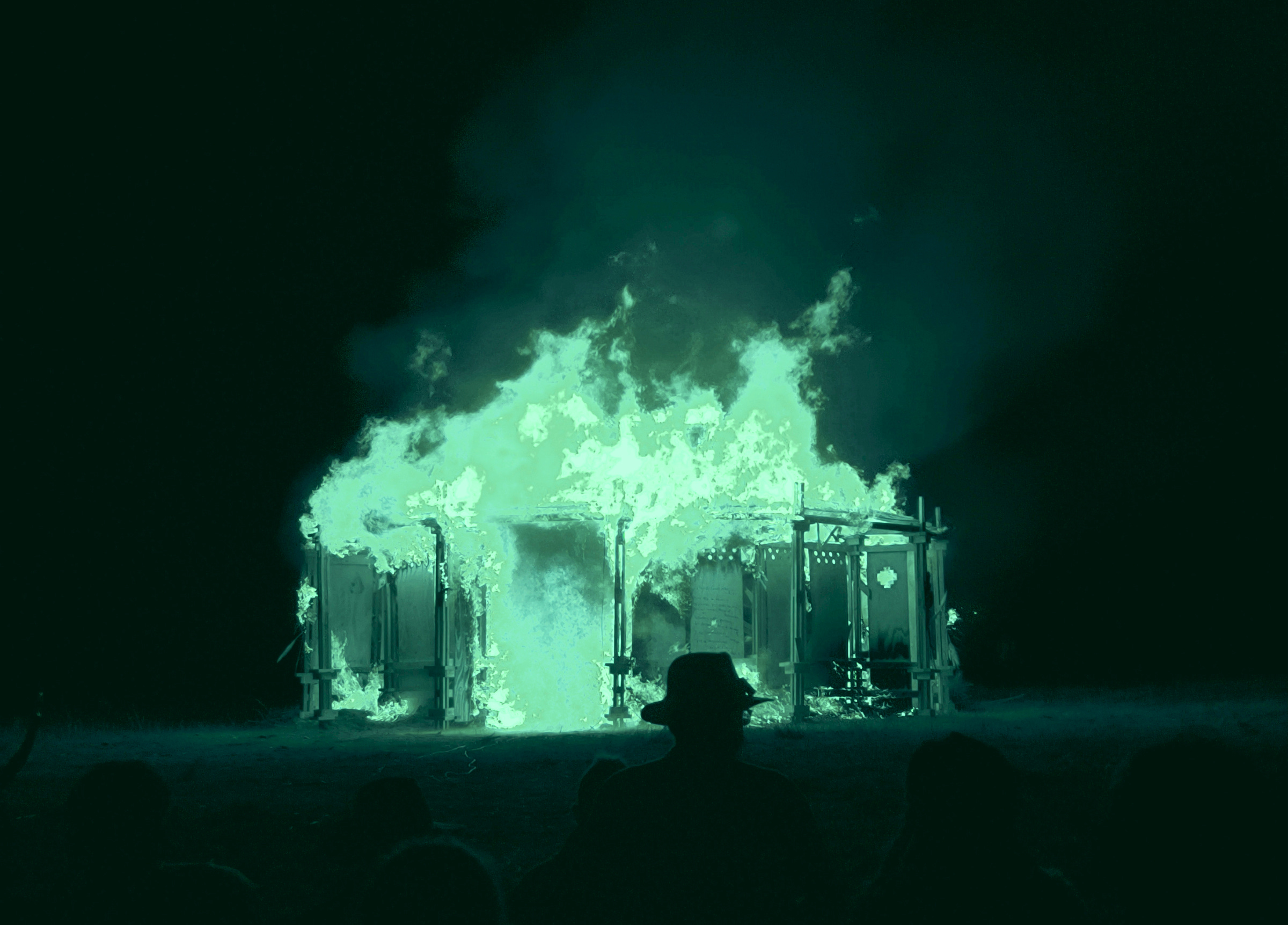
It’s a strange feeling to fill my plate with food cooked by strangers, and simply walk off with a “thanks”. To accept someone’s gifts, creatively prepared, without even knowing their name. At first, I couldn’t help but ask shyly: “and you’re sure I don’t have to pay…?” The answer made me blush: “We don’t ‘pay’ things here.” “Here” - that was my first “Burn”, a participatory multi-day event that experiments with - among nine other principles - the “gift economy”.
On first glance, “Burns” might seem to be a fun type of music festival: there are large amounts of people, there are stages and workshops, and often there are electronic beats and freaky costumes. Many have heard of the largest of such Burns, the “Burning Man” in Nevada, where up to 80.000 people gather in the desert for almost a week to celebrate self-expression, community, and art. Born in 1986 on Baker Beach in San Francisco, it is tradition to burn down “The Man” at the closing of the gathering; a carefully crafted wooden structure going up in flames as a testament to impernanence and a homage to the present moment.
It took me just one “Burn” to realize that, in truth, this tradition is much more than “a festival”, and I was gently corrected whenever I mistakenly used that language. “Burns” are experiments of self-organization, alternative visions of society put to life in a wild outburst of creativity. Every single attendee is both participant and contributor, but never just spectator. Little by little, through each organized “camp” or individual, a temporary “city” is raised from the ground, and by the last day, it is removed and deconstructed to the very last straw. Good communities don’t create themselves, and at Burns, everyone has a chance to practice a lost art: identifying their unique gift to the world. Other than being based on ten fundamental principles, including values such as radical inclusion, civic responsibility, and leaving no trace, anything goes.
In my case, this first Burn was “Fuego Austral”, Argentina’s version of about 600 people. There were at least three to five parties or concerts happening 24/7. There were pools and an all-you-can-drink orange juice bar. There was a tattoo parlour and a box-ring transformed into a neon-coloured danceflour with bouncy ropes. There were informative talks and gong-baths. There was a black-light painting tunnel, a giant twister for adults, a Russian sauna and a pinecone catapult. There was everything and anything. And all of it was free. Sure, you pay a (pretty affordable, in the case of this Burn) entry ticket, because landowners want rent and some basic sanitary amenities are provided, but after that, it’s all gifts.
This “gift economy” was a hugely inspiring experience for me. It moved me, and it made me reflect deeply on the principles underlying our society instead. Rather than embedding the event within our marketplace of goods and services, Burns seek to encourage a “marketplace of ideas and experiences”. For this to work, it needs both participation and generosity. That might sound cute and simple, but as I found out, to someone raised in a society rooted in the logic of “transactions”, it is not. Not only did I feel awkward and strangely guilty for simply “taking” things and attending experiences offered by people who I might never see again, but I also noticed a constant undercurrent of stress about having to pay back, and being recognized for it. Was I cleaning up enough in my camp? Had the others noticed I had helped with the fire this morning? Did they know I’d signed up to volunteer later? When the Yin-Yoga class I had planned to offer didn’t work out due to an unexpected rain (and a tornado, by the way), I was all stressed out.
It took days of getting out of my mind and into my body on the dancefloor, multiple nights of vast night skies, and most importantly, a never-ending stream of genuinely generous smiles for me to realize: I deserve to be gifted. People are doing all this for me (as for everyone else), and the best way to pay my respect is by accepting their gift with gratitude. Considering, just for a moment, the possibility that I might be worthy of all the good that comes my way, that the world wants my joy and happiness, even without knowing my story, even without me earning it first - it opened the floodgates for an inner well of giving that I didn’t know was in me. Suddenly, I was bubbling over with ideas of what I could do for this community, how I could make them happy, and my heart was beaming. It became obvious:
We must receive to be able to give, and receiving is an inner stance.
Most of us are awash in abundance - of safety, food, and shelter, of laughter and beauty, of well-wishing and love, and yet we rarely feel that way. It seems at times that our minds are hell-bent on pointing out what’s lacking in our lives, and our culture doesn’t help. Creating want is a prerequisite for our consumer economy to function. There are certain times when we give, but somehow, consumerism often turns even those into obligations to deliver and perform. “I still need to get that present…” is a phrase I’ve said more than once. Most other times, we simply purchase. Money crosses the table, and this is where the transaction ends. It is a brief contract between those who give and those who get, a relationship limited to the transaction. If we pay, we feel entitled to receive. And if we receive from something in our ownership or someone in our employment, we even feel that we are “owed”, we have the right to receive. A feeling on the polar opposite of gratitude. In truth, all in existence is first a gift of life, of nature and of our Earth, but this fundamental reality couldn’t be further removed from our everyday Western awareness. Growing up in a culture like this has made me an awkward receiver of gifts and a giver driven by the anxiety of having to prove my worth.
Of course, I am painting a picture of extremes, and this isn’t a manifesto for the abolition of all private ownership. It is, however, worth becoming aware that our cultural choices are this: choices. Alternatives exist and are being practiced - at places like “Burns”, but also in numerous native cultures. In her book “Braiding Sweetgrass”, Robin Wall Kimmerer reminds us that the forced introduction of private property has been one of the most heart-breaking assimilations forced upon indigenous peoples in many places around the world, destroying cultures that were previously rooted not in rights but in gratitude, and the deep understanding that all that sustains us is a gift, including life itself.
Why is giving relevant today?
In the brief experiment of my Burn’s gift-economy, I observed the amazing creative power that is unleashed if the foundation of culture is gratitude, and the fuel for giving is not an obligation to “produce” but simple well-wishing. As soon as I allowed the music from the handpan to be played for me, and the smiles sent my way wanting nothing in return, I could think of nothing more fulfilling that giving back. Not out of obligation, but out of joy - a heartfelt creativity that keeps multiplying. It is as if abundance creates more abundance. And doesn’t it make sense? We find what we send out into the world, and when we look at it through the lens of gratitude, we find ourselves awash in gifts. It didn’t matter any longer who exactly it was that I would give to, because all are equally deserving, and giving itself is the point. We were all giving for each other; one community moving together to create, and as such, we were part of something bigger. I wasn’t giving from “my” things or “my” skills, I was simply playing my part.
When our friend gifts us a carrot cake for our birthday, that gift comes from our friend, but even more fundamentally, that gift comes from the carrot plants and nut trees, and from life itself. Ever-fully-stacked grocery store shelves may not make it seem that way, but we can’t take abundance for granted. We create it through reciprocity. Anything, starting from the food we eat to the chestnut table we write on or the cotton fibre we wear, can be traced back to a life given, and thus to its true nature of being a gift. If we recognize this, we’re unlikely to grab more than we need, and we’re moved to give back.
“For in truth it is life that gives unto life - while you, who deem yourself a giver, are but a witness” - Kahlil Gibran, “The Prophet”
This kind of perception is an active choice, and it has radical consequences. The experience of any object, whether it’s a loaf of bread or a pair of new leather shoes, radically changes depending on whether we see it as a gift or as a commodity. Can you imagine how a gift economy - at least in our imagination - would shift our behaviours around our shiniest technologies or most polluting goods?
Realizing how our inner attitudes shape our planet is vital today. In a world where we’re about to consume ourselves to death, an attitude of “enough” is what we need to return to, and gratitude is it’s foundation. It cultivates an ethic of fullness. I am not advocating to abolish all our economic structures and just implement a never-ending global “Burn”. But I am advocating for bringing the gift economy into our hearts. We are at a critical point in history as climate havock starts breaking in over our heads, and choosing the attitudes that will carry us through wisely is critical now. Growing resource scarcity and all the horrors that spring from it might make it hard to look at Earth, including other humans, as a basket of gifts. But could it be that our distrust of nature and our mindset of scarcity is precisely what has brought scarcity about? What would happen if we let go of “rights”, and made the radical choice of gratitude again? I believe we could rediscover abundance. If the food I eat, the shelter that houses me, and the music that reaches my ears are all gifts, would I still take more, so much more, than I need? If I nurtured an attitude of abundance, would I still hoard and protect, or would I share? Could it be that all we really need, we already have, and we simply need to give it more of our attention and care?
“We can choose. If all the world is a commodity, how poor we grow. When all the world is a gift in motion, how wealthy we become.” - Robin Wall Kimmerer, “Braiding Sweetgrass”
At the end of the Burn, I was finally able to gift my class, and the gratitude that came back my way filled my cup for many days. Just like a mindset of lack creates scarcity, one of abundance creates more for everyone. Sadly, in most parts of the world, such principles of gratitude and abundance don’t govern our economies. But even in a market economy of goods and services, we can start to bring about change, one individual at a time: by remembering that nothing we own was ever truly ours, and that all that sustains us is a gift from our earth. It will make us all richer.