Measuring What Matters
The Unraveling Promise of Infinite Growth

About this piece: We are what we measure. What we pay attention to, we become. And in a world where we measure, first and foremost, economic growth, we’ve become productivity machines, running in a race without a destination. Our planet is now asking us a question: if we are what we measure, then who do we want to be?

If I could tell you one thing about your future, what would you like to know? Would you ask me whether you’re happy? Whether you’re healthy or whether you’re safe? Or would you ask me about your country’s annual GDP growth?
It’s unlikely that in finding out whether you’ll have a good life, you’d see much relevance for this abstract metric. And yet, GDP and its annual growth rate are our measures for a striving nation. Although most of us are not quite sure what “gross domestic product” even means, we rank countries and their “development” by it - the higher, the more we look up to it. GDP describes “the total market value of all final goods and services produced within a country in a given period of time”. In other words, it’s “the economy”. Even more important is GDP growth, or how much our economy expands. It’s first and foremost on our national news. GDP growth rules our world, from policy choices to investment decisions, from societal values to electoral success.
Of course, measures like health, love or fulfillment are much harder to measure than production in dollars, and so, you might argue, GDP is simply a good metric to make sure these more abstract aspirations are met. A wealthy nation can afford better education, healthcare, and infrastructure. Thus, a growing economy is assumed to translate to more jobs, comfort, wealth, and longer lives – a simple positive for existence, or so goes the logic.
Thus, we ignore the side effects of growth. These side effects, however, are huge. More production in a fossil-based industrialized growth society means more consumption of materials, more energy and water use, more carbon emissions. It means more destruction, more pollution, and more loss. It means more global warming. And this warming has come to a critical stage. Some countries have entered the stage of digging anticipatory mass graves before summer to prepare for ever more brutal heatwaves. 75% of young people in the world are now scared of their future. And that’s only the climate part of the picture.
In 2025, a “Planetary Health Check” assessed the state of our “Planetary Boundaries” - the critical limits of our planet’s vital natural systems—like the atmosphere, forests, and oceans—beyond which significant, potentially permanent damage to Earth’s stability occurs. Staying within these boundaries is essential for life itself. The report revealed that as of today, humanity has already crossed seven of nine of those boundaries, including biodiversity loss and freshwater flows. The planet’s message is loud and clear: if we keep growing as we do, we’ll end up wiping ourselves out. But for the most part, we keep sawing at the branch we sit on.
Because environmental destruction simply seems an unavoidable side effect of economic development: GDP growth and CO₂ emissions have been closely coupled ever since we started measuring. It is the reason that “developing countries” have argued for concessions in their emissions reduction targets, and it is the reason the world has granted them. Research found that out of 150 nations studied, none had met basic needs while also staying within its biophysical limits; in fact, planetary boundaries have been crossed faster than needs were addressed. It seems we’ve settled on the conclusion that we’re looking at an unavoidable tradeoff, a necessary evil, rather than fundamentally misguided priorities, but I beg to differ. If we want a happier life, and any life at all, we must begin to imagine otherwise. A future that avoids catastrophic tipping points in our climate system, a future limiting warming to 1.5 °C by 2100, requires global CO₂ emissions to fall by nearly 55% by 2035. The question imposes itself: can we keep growing forever?
Despite the compelling reasons, posing this question is still ballsy because GDP growth has been married to capitalism ever since WWII, and calling either into question still seems akin to blasphemy to many. The mere act of pointing out growth's side effects can lead to being branded a "communist." Even in the international organization I previously worked for, a highly-regarded institution modelling consumption and emission futures, GDP growth assumptions are kept identical between “business as usual” and “climate-friendly” scenarios. A reduced trajectory associated with the greener pathways would simply make governments cast aside their analysis altogether.
We want to believe continued growth is possible. Maybe the problem in “fossil-based industrialized growth” was never the “growth” but the “fossil”. Maybe, if we could just replace our source of energy, use better materials and make everything more efficient (perhaps with AI), we could keep riding the wave of “progress” indefinitely. This view, shared by "green capitalists" (a group I once belonged to), sees "green growth" – of GDP, naturally – as the goal of nearly every international institution and national government. It promises us ongoing growth in comfort and wealth without lifestyle changes, even in times of climate catastrophe, through technology, innovation, and carbon pricing. “Green Keynesians” are mostly on board with this approach, but demand more government intervention to guide markets, exemplified by the Green New Deal.
Both camps point to solar panels, electric cars, or other technologies, and credit them for the beginning of “decoupling”: the process of separating GDP growth from emissions. A reason for hope? The allure of a solution without fundamental change sounds compelling, even for me. But behind the “decoupling” lie hidden truths: the impact of trade (production-based versus consumption-based emissions, or “carbon leakage”), the lack of decoupling from other environmental damage, or the fact that the cumulative total of emissions in our atmosphere has not decoupled from GDP at all. And it’s this cumulative effect that drives climate change.
“Economic growth has a near mythical status in the affections of economists and politicians. But wishful thinking won’t solve the climate crisis. Post-growth economics offers us more choice, more realism and more insight into the possibilities for human prosperity. It’s not about returning to the cave but about breaking free from our intellectual prisons.” - Tim Jackson, professor of sustainable development at the University of Surrey and a leading post-growth economist.
Relying on the “decoupling” of growth and emissions as a strategy would land us in disaster: the goal we need to reach very soon is not lower emissions per unit of GDP, but “net-zero”, a.k.a. no emissions at all. Despite absolute decoupling starting in some countries for parts of their emissions, the reductions made to date fall significantly short of what’s needed for climate goals. At their current pace, high-income countries would need over 220 years to reduce emissions sufficiently, let alone those countries that have been made concessions. The current trend is betting on technology, notably AI, to deliver this miracle. But it’s a gamble that would cost us everything.
Because emissions are merely one symptom of a deeper disease, one colour in the Rubik’s Cube that is our planetary system. Green growth is still growth, continuing to push against other Planetary Boundaries. Biodiversity loss, the accelerated extinction of life, is the biggest threat to planetary stability, and cannot be reversed by economic growth. It requires a profound cultural shift towards respect and reciprocity for the living world. Wiping out around 200 species per day is not just a “threat”, it is deeply immoral. It’s time that we restore our honour.
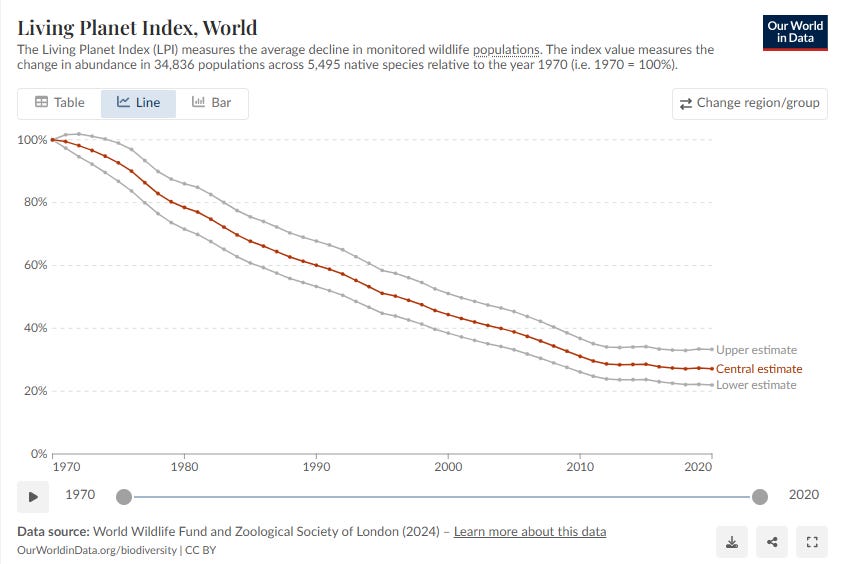
Source: Our World in Data, The 2024 Living Planet Index reports a 73% average decline in wildlife populations — what’s changed since the last report?
Just like the atmosphere doesn’t care about arbitrary borders and accounting systems, the web of life doesn’t care about singled-out metrics irrelevant to how it functions. Would you judge the health of your entire physical body by the digits on your bank account? For me, the question that emerges as I wonder what a good life really is is not can we keep growing, but do we want to?
An economy driven by growth, not balance, produces for production’s sake, not for communal good. It’s the type of economy that floods dollar stores with single-use vapes and novelty gadgets that the world doesn’t need, but pays for. An economy driven by growth, not balance, celebrates new needs being created, such as mangoes from Asia in the markets of France, especially if that creates new shipping routes for oil-filled giants with it. An economy after growth turns people into productivity machines, working for no meaning other than paying their loans off so that their kids can go and do the same. The spiritual emptiness and disconnection that many of us feel is no coincidence: a society that strives forever forward is never quite here, and a system that always needs more has never enough. A sense of want is hardwired into consumerist capitalism and its striving for more.
If GDP actually measured what matters - happiness, health or connection - I’d be on board. Invented by Simon Kuznets to gauge the impacts of the Great Depression, it misguidedly became a post-war guiding star for a world seeking distraction. Today, we cling to it like to the holy grail. In truth, GDP is a very poor proxy for anything meaningful. It tells us nothing of equality or distribution of wealth; GDP can be high and getting higher while income inequality surges, or all wealth is extracted by foreigners. Capitalism, the system to which GDP is married, is fundamentally aimed at the accumulation of capital in the hands of those who had anything to begin with, favouring an ever increasing gap in wealth. Our economic system is not “broken”, it’s doing what it was designed to do, and at ever faster rates. Our problem was never that there isn’t yet enough - of food, of wealth, of energy - but how we distribute it.
GDP and its growth tell us nothing about whether the physical realities it extracts and produces from - a.k.a. our ecosystem - remain healthy and able to give in the long-term. Its incredibly short-term oriented. Indigenous thinking in many places made political and economic decisions with seven future generations in mind - how can we be good ancestors to our descendants? Our short-term growth logic meanwhile barely extends to the next two quarterly shareholder reports.
Most importantly, GDP growth has absolutely nothing to do with a fulfilling life. The narrative we’re being fed tells us that having more will finally bring happiness and that comfort will bring peace. The escalating mental health crisis is saying otherwise. After decades of “successful” growth, depression and anxiety are at an all-time high. In the US, one of the richest countries in the world, suicide rates are also among the highest. The quest for material wealth, particularly at the cost of other life, often reveals only, in the words of a monk at the recent US peace march, a “deep inner poverty“.
So why this madness? Why do we seek growth rather than harmony, even at the cost of our only home? The answer may lie at the depths of the human psyche, wrapped up in our very sense of identity. Our "ego," an evolutionary advantage fostering individuality, comparison, and planning, also breeds fear, anxiety, and self-centeredness. “More” is the ego’s bread and butter; the voice in our head is never satisfied. Once one desire is fulfilled, the next one steps on stage. The ability to project into the future has made us rein over the Earth. But with our power, we have forgotten our responsibility: to safeguard balance and make life prosper, for everyone. Buddhist thought calls this force “craving”, and it is a bottomless pit. We crave for the sake of craving. Do we grow for the sake of growing?
Our ego’s mechanisms play out culturally: when we don’t taste our dinner because we’re already planning dessert, when we divert attention from the real to the virtual to gain likes on social media, or when we focus on “career” as our life’s primary purpose (because a standstill means we’ve lost). It also plays out on a much larger scale. We assume that all demand is inevitable and that it must be met. In truth, demand is politically, economically, and culturally constructed. The systems we are part of are nothing more than an expression of us, an agglomeration of people and their ideas. And for our egos and economies alike, more is more.
For our only home, our Planet Earth, a different law prevails: balance. “More” simply means that at some point or another, there will be “less”. Whatever expands must contract, from our lungs to our lives. Nature, our real government, exists in cycles, flowing forward in an endless give and take. We’ve been taking, and for a couple of generations, we - or rather, some of us - had a blast. Now it’s payback time. A recent analysis by The Guardian warns that “flawed economic models mean that climate change might crush our economies”. Were we just growing towards oblivion? If we want to evolve with what our environment is asking from us today, we must learn not just to stop taking, but to give again.
Our current system is built on intelligence, but not on wisdom. In the far East, there’s a country that decided to measure happiness rather than GDP to guide its political decisions: Bhutan. But even here in the West, the voices with the wit and the courage to demand change are becoming more numerous. Earlier this month, UN secretary general António Guterres warned that humanity’s future required the urgent overhaul of the world’s existing accounting systems: “When we destroy a forest, we are creating GDP.” Even the mainstream outlet The Guardian recently published a brilliant critique of our growth-logic. And alternatives, real alternatives beyond just repackaged “green growth”, exist:
Kate Raworth synthesized ecological economics, social justice and sustainability into what she termed “Donut Economics“. She presents an economic model that aims to meet the needs of all people within the means of the living planet (wonderfully explained in the inspiring podcast below). It visualizes a safe and just space for humanity, bounded by two rings: an inner ring, representing the minimum standards for human well-being, and an outer ring, representing our planetary boundaries. The “donut hole”, right in the middle, is the sweet spot: balance. Here, humanity can thrive, generation after generation, together with the rest of life.
Implementing Donut Economics requires transforming business, finance, governance, and culture, valuing well-being over endless growth and “progress”. All this starts with changing what we measure. Governments such as New Zealand (with their“Wellbeing Budget“), Italy, or Scotland are already incorporating broader metrics, replacing GDP with dashboards with a range of social and ecological indicators. But simply measuring more won’t make a difference; only prioritizing differently will. This is where “degrowth” comes in. If a conflict arises between two measures, say GDP growth and CO₂ emissions, what do we choose? Economists like Timothee Parrique advocate boldly for a downscaling of production and consumption for a number of years, a macroeconomic diet of sorts, with a new primary goal: restoring our life support system, until we reach a point of balance. In his words (on the podcast below): “Prosperity in the 21st century will not be defined by one indicator made up by one dude in the 1930s. We have different aspirations.”
Many localities are already pioneering post-growth, post-carbon, or solidarity economies. Some call them “well-being economies”. It is up to us now to support and elevate them to become viable economic alternatives. As Timothee Parrique says: “government is a very good muscle but a very poor brain. We should not expect any government ever to be the bearer of a utopian vision. These always come from civil society”. And civil society, that is us - you and me. Our future is up for grabs, so what does a “well-being economy” mean to us? It could mean producing what we need, and consuming in moderation. It could mean rewarding financially those services that truly matter to our humanity, not those that propell us “forward” to no end. It could mean nurturing the lives that sustain us rather than exploiting them. And it will certainly have to mean embarking on a culture-wide inner transformation, becoming aware of our egos, and replacing want with gratitude.
When I project into the future of my children, unborn as of yet, their GDP growth is the last thing on my mind. What I am interested in is whether they will be safe and healthy, whether they will feel fulfilled, and whether they will have loving relationships with each other and their world. I imagine them in a green space, a garden or a forest, enjoying the planet they were born into. What I care about is whether they will feel at home there. I wonder if, when they look back at this time, they will find the striving for infinite growth on a finite planet utterly absurd. Sure, we can invent ourselves to Mars to expand beyond even that very planet, but I would rather have my feet on Earth.
At our deepest level, what we value the most is immaterial: we want to witness our one and only life in contentment, we want to discover its meaning, and we want to love. Our planet is offering all this graciously, as long as we live by its law of balance. To rediscover it in our culture, we must first rediscover it inside. Our outward world is nothing but our mirror.
There was a shift in our consciousness when we first discovered ourselves as individuals with aspirations, and it has changed the path of the world. But in this story much bigger than ourselves, there are no mistakes. A shift in consciousness can happen again. Our environment is asking us to evolve . And this time, it’s toward returning to the whole. Grasping for more might be part of human nature, but so is the unique ability to act wisely in service of the bigger picture and see that what’s good for the Earth is what’s good for us.