When We Forgot About Plants
A conversation with Amazonian scholar Luis Luna on plant intelligence, consciousness, and the relationship the West forgot

“We are living in an incredible, extraordinary place, full of intelligence. I mean, to realize this is such an adventure — we could spend our life just by wondering about this marvelous place outside.” - Luis Eduardo Luna
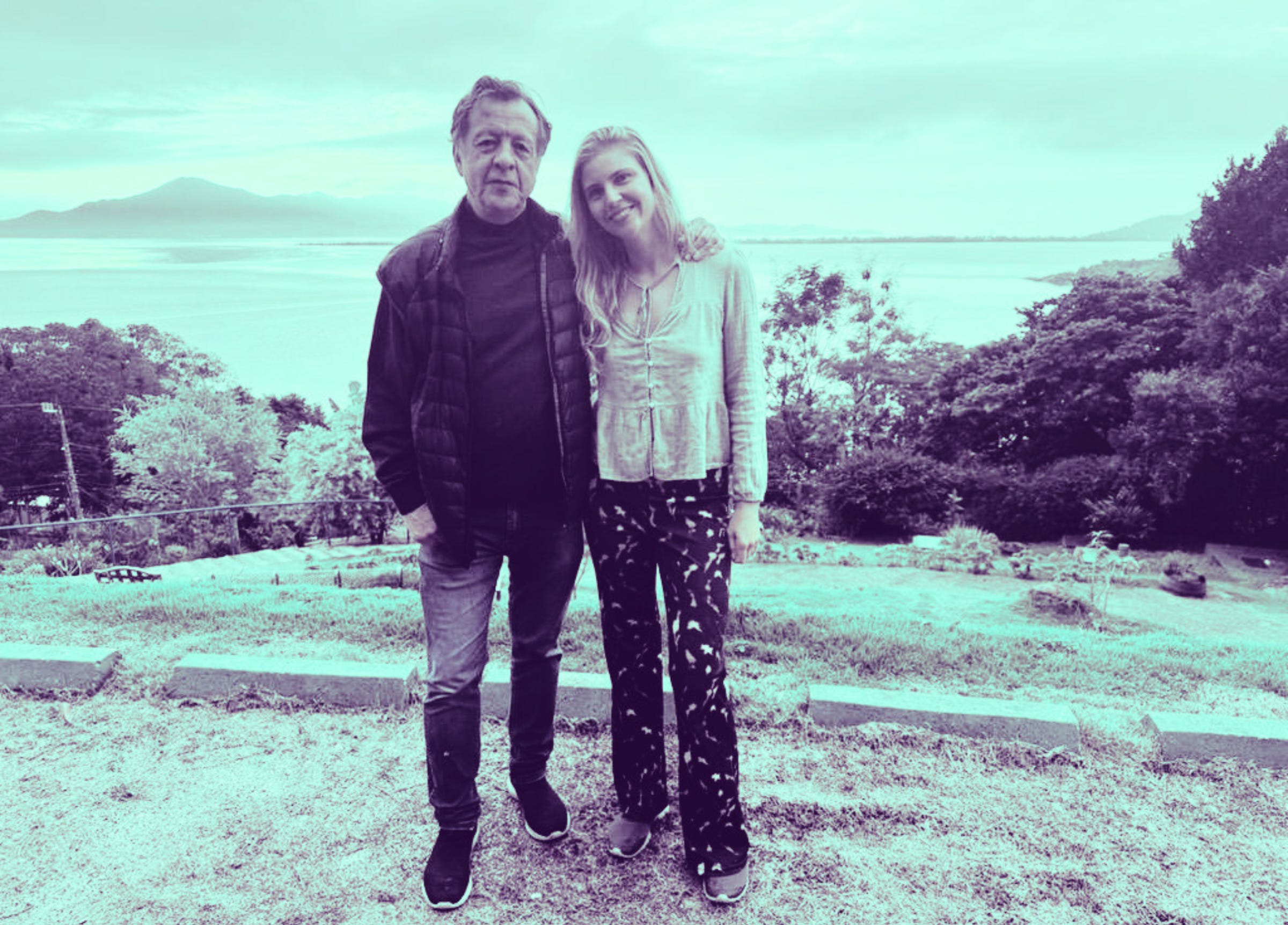
When I sat down with Luis Luna at his home in Brazil, I had the feeling of speaking with someone who has spent his whole life trying to help us remember something the modern world forgot. Born in the Colombian Amazon, he has spent a lifetime bridging worlds — shaped by philosophy, theology, literature, and anthropology across four continents, he has also spent over 45 years in relationship with indigenous Amazonian communities. I spent four months at this research center in Brazil, dedicated to the intersection of sacred plants, consciousness, and indigenous wisdom. This time profoundly changed the way I relate to one part of the living world in particular: plants. At a time when it is becoming increasingly apparent that something in the way the West relates to the world is broken, speaking with Luis felt both timely and uplifting. In this conversation, Luis and I explore the essential question we always circled back to: what does the living world know, and how do we learn to listen?
Leonie: In Amazonian cultures, some of them much older than the culture I grew up in, how do they relate to plants? And how is this different from how we relate in the Western world?
Luis: In the Western world, we have something called “plant blindness”. Which means that for most people, plants are just something green. Say there is a tree, and we can cut something out of it, like wood… the plants are considered passive, completely devoid of any feelings, of intelligence, awareness, and so on. That is the Western way of looking at things. Most people don’t even know the names of the plants of their own place, because most people live in cities, far from nature, from trees. So we are not only plant-blind, we are nature-blind - to winds, to rains… Most people don’t know what kind of moon we have. […]
What a difference it is to be in nature totally. Like the Amazonian people. Their relationship is completely different, because most Amazonians — and many other parts of the world — are animistic. Animism means that everything is intelligent. We’re talking about nonhuman persons, animals are persons, and it all comes from the mythology: they have the idea that animals, even animals that you eat, were our ancestors. That in the primordial world, all were human. So in their relationship with the living world, of course, they have to kill animals, but the animals are kin. It’s family. So the deer that you’re going to kill — mentally you know it’s family, and then you kill it. Because you know that you need that in order to be able to live.
Leonie: Because all life must eat.
Luis: All life eats from each other. It’s different when you kill an animal because you just want to eat, or when you have that kind of relationship where it is kin. And then you realize that in their world view, they are related to everything. All is family. And that is a beautiful thing, that all is family. Philippe Descola said that in a way, the difference between nature and culture doesn’t exist. Because if nature is full of spirits, of people, of intelligence, all that - then it is culture. You have sociality, you have reciprocity, you have respect, you have negotiations, because you have to eat. And suddenly, the whole natural world is a social world.
Leonie: A cultured world.
Luis: A cultured world, exactly. And in a deeper sense, even more than culture: family. Because when you are related, the whole thing changes. There is a feeling of home. Home is planet Earth. Of course they didn’t have the perspective that we have now on the whole planet, but the idea of land as Mother, of Earth as Mother, and the idea - very common - of the sun as Father - it makes total sense: the plants are transforming the sun’s energy into food.
Leonie: In this way, plants are on the edge between “the father” and “the mother”. The plants take the energy and give it to the people.
Luis: Exactly.
Leonie: Which is interesting when you think of psychoactive plants — they can open the mind to the divine.
Luis: Well, we have a problem in the Western world with such concepts. When you say “psychoactive plants”, you think of Peyote, Ayahuasca, San Pedro Cactus, and so on. But in the minds of the Amazonians, there is no such thing as “psychoactive plants” and “not psychoactive plants” — there’s a duality there that doesn’t exist. Everything is intelligent. Some plants facilitate this kind of contact more than others, or in different ways. Like coca in the Amazon and the Andes: they chew it, and it […] causes clean thoughts, harmony; it doesn’t give you visions, but it can give you clarity of thought. Other plants will give you something else: […] there are plants that help you with access to dreams, others with access to visions. […] This shows us how these people have been able to relate to the plants in a different way - they know. In the West, we say “yes, he knows a lot about plants”, because he knows the Latin, scientific names of them. But the way these people are learning is completely different.
Leonie: For the West, it is “about” plants, not with…
Luis: And for Amazonians, it is multisensory, and it goes both ways. They are learning from the plants, and the plants are learning from the people. The learning is in the relationship.
Leonie: This is something I wanted to understand better. How do the Amazonian cultures learn from plants?
Luis: If you ask them, they might tell you “my intricate dreams have shown me…” or “if I take Ayahuasca, then other plants present themselves”. Because it is about relationships. And the knowledge they have [translates into the physical]: people from the Yanomami culture — they have the richest biome in the world in terms of species of microorganisms. And that’s because they eat from something like two hundred different plants. The knowledge of plants they have is just huge. Compared to us…
Leonie: Some people never eat a carrot.
Luis: Very few species in general. And they recognize what is good for them, because they are always in relationship with the plants. It’s another kind of mental world, which unfortunately we have been losing because of the heavy impact of Western ideas, conquest, and colonialism.
Leonie: Yes, you brought up an interesting point with the distinction of “psychoactive” versus “non-psychoactive plants”. Now that psychedelics are interesting to the West again, there is suddenly also an interest in psychoactive plants, but only the “psychoactive”ones, the ones that blow your mind and can make an interesting experience, but not in the millions of other plants that have other things to teach.
Luis: Yes, a very good example is tobacco. Tobacco is a very, very sacred plant. In the Amazon, even today, it is always used in a context of healing, in the preparation of other plants, etc. In the Western world, they found tobacco, then added chemicals to make it stronger, make it addictive, and now people die of cancer. The same thing with coca: extremely nutritious, it gives you clarity of mind. It does absolutely not cause any kind of aggression or negative feelings, just peace. But then we extract cocaine, which is only one of the many components, when it’s combined with alcohol… I mean, it is just a disaster.
Leonie: Where do you think this is coming from in the West, this attitude?
Luis: Well, I don’t know, but I think we have to go back in time to Europe. I know a little bit from Marija Gimbutas, an archaeologist and folklorist from Lithuania. What I understand from her is what she called in “Old Europe” — there were societies in the Neolithic time, living in peace, with no defensive walls, no weapons, Ceramics, weaving, singing, of course.
Leonie: Pagan cultures?
Luis: Yes, Pagan cultures - all over Europe. Before the Indo-European invasion. Then they came with the “sun god” and axes, and the old cultures in Europe [mostly] disappeared […]. The indigenous peoples of Europe disappeared. And it became this. Which continues to hold many old ideas, though: sacred groves, sacred trees — Iddragsil, for example. Or Odin, who gave the eye in order to learn from the tree. You still have these ideas.
Leonie: A type of animism?
Luis: Yes, it was. Marija Gimbutas writes how the Prussians talk about how they adored the sun and the moon and the stars, and the animals. Something happened, and it would be interesting to understand the archaeology of this kind of different way of thinking.
Leonie: Absolutely, I’m very interested in that. Especially after getting in touch here with ancient lineages, such as the Huni Kuin or the Yawanawa, that still hold such wisdom, I don’t know my lineage. It’s been broken like 2,000 years ago, and I want to find it again. I’ll do my best.
Luis: I think everybody should — to recover, to go back to our ancestors and see what they were doing. Expand your idea of time, and then perhaps you realize that instead of, or at the same time that you are looking at societies in which animism is more present - the Huni Kuin, the Shipibo, and so on - you might discover that your ancestors back in time also lived like that.
Leonie: It’s the quest of our time, for young people: to reconnect. And speaking of animism, it’s a fundamental idea that there is intelligence and consciousness in non-human life. Some even believe that it is in absolutely everything.
Luis: That is something that is coming back now. David Chalmers and many others — forms of pantheism are now coming back, even in science, in physics. It’s very interesting… We have already recognized this for that certain primates that are very close to us, gorillas, orangutans, of course. And then you go back — dolphins, certain birds, other animals — look at your cats and dogs, then you understand; the consciousness is clearly there. But go back more… biologists are going back in animal intelligence, and finally also into plant intelligence. So also from a scientific point of view, we are discovering - rediscovering. And suddenly you realize that animistic societies were right, all along. We have to overcome the human-centered way of thinking. […]
Leonie: That’s true! And you’re right, science starts to converge with what you may call spiritual, animistic ideas that are very old.
Luis: It’s the recognition that we are living in an incredible, extraordinary place, full of intelligence. I mean, to realize this is such an adventure — we could spend our life just by wondering about this marvelous place outside, the animals, the plants, the people, the varieties of culture… Instead of fighting for some kind of idea - nationalism, racism…
Leonie: Or for endless pleasures and growth, for a little more oil… Yes, I believe that life around me is conscious, and I have always had this feeling. But I grew up in a family of biologists, and although they taught me much about what each tree is called and all these things, we had discussions about their consciousness, because still today — I think for most, even for biologists — the thinking is that only humans are conscious. The rest is just stimulus-reaction, blind stimulus reaction.
Luis: Yes, “mechanism”.
Leonie: It’s all a machine. Would you say to people who think that way?
Luis: In the Western way of thinking, we are always into cause and effect, and division, concepts, things. […] This is so strong in our way of thinking about the world that we are unable to recognize other kinds of intelligence or other ways of understanding the universe. Thomas Nagel asked the question: what is it like to be a bat? And of course, in our imagination, it’s very difficult to think of an animal that has no eyes, and lives in a completely different world. But here is the thing: indigenous people apparently have this imagination sometimes. And this brings us to the really big question: these sacred plants, what is their function? Apparently, one of the functions is to be able to see the world through another organism, through transformation. Once you understand this concept, suddenly you begin to see that a lot of the iconography of the Americas is all about transformation. And not only in the Americas. Because go back to the Paleolithic time in Europe, what do you see? You’ll see transformation too — “les trois frères” in the cave, images of half-animals-half-humans in Northern Italy. In Northern Italy, you have the very first iconography of a modern human being in Europe. It’s everywhere.
Leonie: Life is always changing, changing…
Luis: Everything is always changing. And there is a big difference between this kind of way of thinking, and the Western way of thinking. You can even see it in languages. Robin Wall Kimmerer writes that in the Potawatomi language, the percentage of verbs is about 70%. […] They have only 30% “things”. In European languages it’s the opposite. We live in a world of “things”. And they live more in a world of …
Leonie: Process?
Luis: Process, exactly. This is a completely different way of looking at things.
Leonie: Do you think the plants outside perceive when you are around?
Luis: I think so. I mean, obviously, they perceive. If you put a plant and there is another plant growing on top, she knows that something is blocking the light, takes decisions to find a way around… I was reading this philosopher, I forgot the name, who said that they are “even more in the world than we are”, because they cannot move, they move only by growing. So they have to understand the place where they are really well, in order to survive, and make changes. The plants are really here.
Leonie: Yeah, supposedly, they are not lost in thought, so they are always perceiving with their senses.
Luis: With all their senses. And they have so many. Not only do they feel light, they detect sound, that has been proven. They detect gravity, temperature, water, and humidity. They are exchanging nutrients with other plants. That’s thinking, you know. They are intelligent. How could you say they are not?
Leonie: I guess many of us humans only know thought-based decision-making, like you said - cause and effect, one thing to another thing. But there is also intuition, taking decisions out of the void, based on what you perceive with your senses. In mental healing, this play a big role for people, to connect again with this intuitive decision-making in their life. So there is a lot to learn from plants.
Luis: It is a materialistic way of thinking to put aside intuition. For the Greeks, intuition was divinity.
Leonie: For the Western world, it is immaterial, [and so it is irrelevant]. I wanted to ask about the current world situation. If we could give the microphone to the plants right now and ask them what they would tell us, what to do, how to handle it, what would they tell us?
Luis: I don’t know what a plant would say; I can only try to give some voice to something from my point of view, which is human. It’s like Nagel said - what is it like to be a bat? No idea. Now, what is it like to be a plant? Wow, it is so far away from us; time is different, and all that. But clearly, what we’re doing is just totally crazy. […] It is the so-called sixth extinction. And we are deregulating… Life’s been working for millions of years to get us to this fantastic balance. We can live in good temperatures. This is in fact a very short geological period in which we have this marvelous place. In other times, it has been very difficult even to live. Many plants will be able to survive, but we will not. So I think the plant would say: look at what you are doing. You are going to destroy yourself. Life will continue.
Leonie: Thank God. There’s this great book called The Overstory, by Richard Powers. What you just said reminded me of the bottom line of the whole book — you read it and you think it’s a book about humans trying to save the trees, and in the end you understand that it’s been the trees trying to save humans from themselves.
Luis: Very good. […] We are a very young species; we just came here. We think of homo erectus, who was here 1 ½ million years. Compared to homo erectus, we are teenagers, doing lots of crazy things, we are not fully mature yet. So perhaps we are going to mature half a million years from now.
Leonie: And compared to the age of plants, incomparable.
Luis: We are babies.
Leonie: Maybe to close - if you would have advice for anyone who feels like they want to change their relationship to plants, and wants to actually stop just learning “about” plants, but get into a relationship with plants — what could they do?
Luis: Well, I’m a scholar, so I would say go back in your history, in your ancestry, and learn what was the relationship to plants. Learn about the plants around you. Start to see them. […] Learn about the plants around you. Be aware of the plants you eat — where are they coming from? Can you increase the diversity in your diet? And then go to the forest, try to get the experience of nature, and try to diminish this radio noise in your head, telling you things all the time. Try to communicate with what is around you in a non-verbal, non-conceptual way. Just be in a place without this mental chatter. Just be there. And then you might have access, perhaps. Our mind causes a lot of noise. It will go over any other possibility of communication that is more subtle.
Leonie: This has been my experience, for sure: turning down the mind and trying to communicate through the senses, I sometimes feel like I’m greeting the tree, I feel like I’m saying thank you. And there is this feeling that something is coming back. It’s hard to put into words, but there’s something there.